
Book Review
Head First Design Patterns: A Software Engineer’s Book Review
“Design pattern” is one of the first architecture terms most software engineers encounter. We watch tutorials, read blog posts, and memorize class diagrams—but knowing a pattern’s structure is not the same as understanding the design pressure that makes it useful.
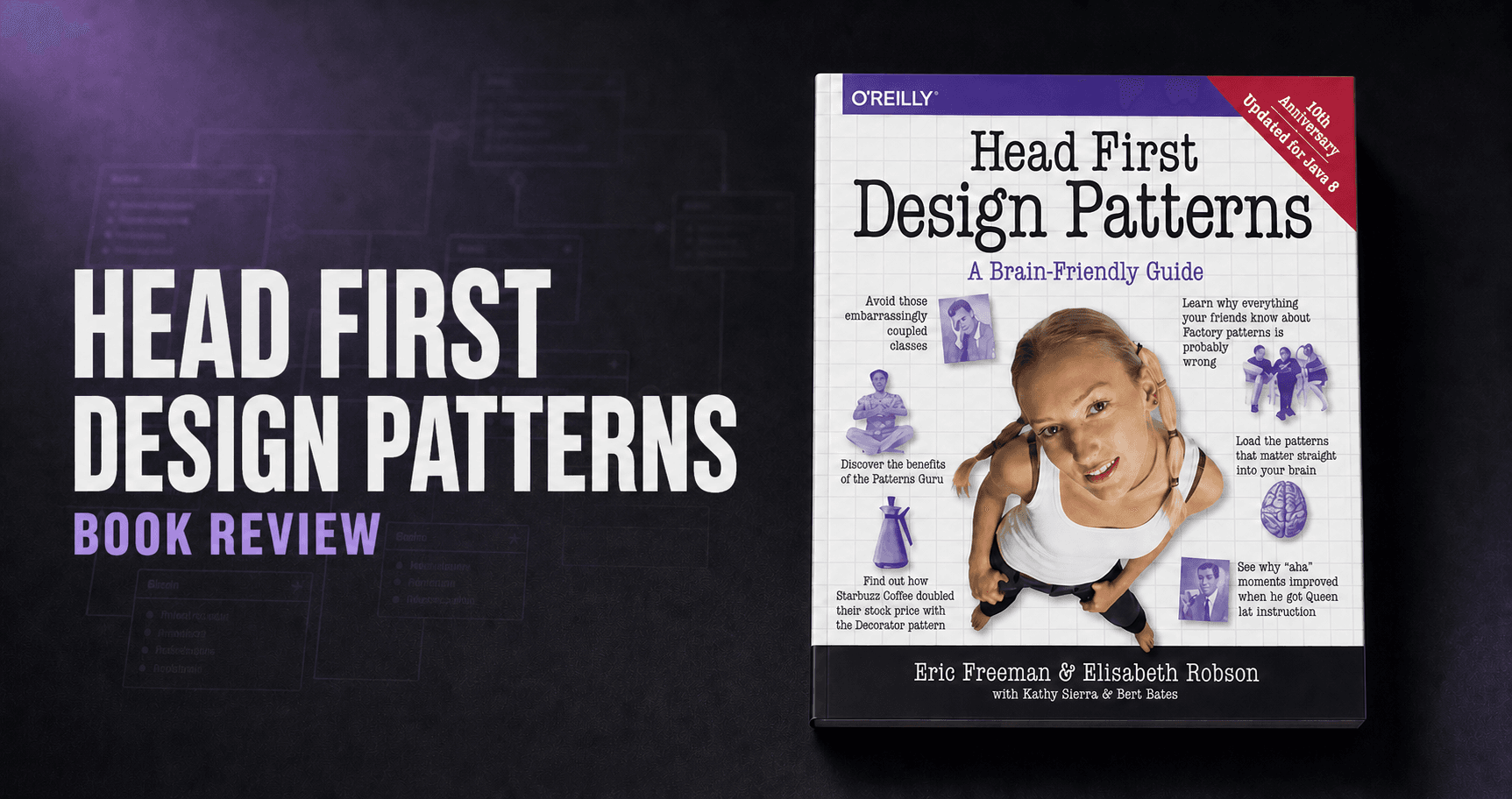
This is not another tutorial about Strategy, Factory, or Observer. It is a review of the book that gave me the clearest introduction to the subject: Head First Design Patterns by Eric Freeman and Elisabeth Robson.
The Book at a Glance
The copy shown here is the 10th Anniversary edition updated for Java 8, based on the original O’Reilly title first published in 2004. The update modernizes the Java examples while preserving the visual, conversational teaching style that made the book popular.
Authors
Eric Freeman and Elisabeth Robson, with the Head First learning approach created by Kathy Sierra and Bert Bates.
Edition
The 10th Anniversary update for Java 8, based on the original O’Reilly edition.
Format
A substantial visual learning guide designed for active study rather than quick reference.
Examples
The examples use Java, but the design ideas transfer to PHP, Laravel, C#, TypeScript, and other object-oriented environments.
Why the Teaching Style Works
The book rarely starts by presenting a formal definition. It starts with a small application, introduces a believable change request, lets the design become uncomfortable, and then develops a pattern as the response to that pressure.
The opening SimUDuck example is a good illustration. Inheritance appears reasonable until different ducks need different flying and quacking behavior. The book does not simply announce the Strategy Pattern. It lets you experience why the original design becomes rigid, separates the behavior that changes, and only then gives the resulting design a name.
That problem-first sequence is the book’s strongest quality. A pattern stops feeling like a diagram to memorize and becomes a response you can recognize when similar pressure appears in your own codebase.
Visual Explanations and UML Diagrams
Head First books are intentionally visual. Pages combine illustrations, dialogue, annotated code, exercises, questions, and simple UML-like diagrams. The layout can initially feel unconventional, but it continuously changes how the same idea is represented.
For design patterns, that matters. A class diagram shows the static relationships; the story explains why those relationships exist; and the code demonstrates how objects collaborate at runtime. Seeing all three reduces the gap between “I recognize this UML” and “I can apply this design.”
The Patterns Covered
The main chapters build a practical path through the most frequently discussed object-oriented patterns. Some chapters pair related patterns, and the Compound Patterns chapter shows how several patterns collaborate rather than treating them as isolated recipes.
- Strategy — encapsulating interchangeable behavior.
- Observer — keeping dependent objects updated without tight coupling.
- Decorator — adding responsibility by wrapping objects.
Factory MethodandAbstract Factory— moving object creation behind stable interfaces.Singleton— controlling access to a single instance, along with the trade-offs this creates.Command— representing a request as an object, enabling queues, logging, macros, and undo.AdapterandFacade— translating an interface or simplifying a subsystem.Template Method— fixing an algorithm’s structure while allowing selected steps to vary.IteratorandComposite— traversing collections and representing part-whole trees.State— movingstate-specific behavior out of large conditional blocks.Proxy— controlling access through remote, virtual, and protection proxies.- Compound Patterns — combining patterns, with
Model-View-Controlleras the central example.
The appendix also introduces additional patterns more briefly, including Bridge, Builder, Chain of Responsibility, Flyweight, Interpreter, Mediator, Memento, Prototype, and Visitor. This distinction is useful: the book teaches a focused core deeply and treats the remaining patterns as directions for further study.
The Principles Underneath the Patterns
The real value of the book is not the catalog of pattern names. It repeatedly returns to object-oriented design principles that explain why the patterns work.
- Identify the parts of an application that vary and separate them from what stays the same.
- Program to an interface, not an implementation.
- Favor composition over inheritance.
- Design objects that interact through loose coupling.
- Keep classes open for extension but closed for modification.
- Depend on abstractions rather than concrete classes.
- Talk only to close collaborators—the Principle of Least Knowledge.
- Let the framework call application components—the Hollywood Principle.
- Give a class one reason to change.
Several of these ideas overlap with SOLID, especially the Open-Closed Principle, Dependency Inversion, and Single Responsibility. However, I would not describe this as a complete SOLID reference. The book teaches principles in the context of concrete design problems, which is excellent for understanding them, but readers who want a systematic treatment of all five SOLID principles should use an additional source.
What the Book Does Especially Well
- It explains why a design needs to change before introducing a pattern.
- It connects code, object collaboration, and UML instead of teaching them separately.
- It uses recurring stories and examples that are easier to recall than abstract definitions.
- It presents pattern vocabulary as a communication tool for engineering teams.
- It emphasizes trade-offs and reminds readers that patterns are not magic bullets.
- It includes exercises and “Brain Power” questions that reward active reading.
The shared vocabulary point is particularly important in professional teams. Saying “this boundary could use an Adapter” or “the varying behavior belongs behind a Strategy” can communicate a design direction quickly—provided everyone understands the trade-off behind the name.
Where the Book Has Limitations
No technical book fits every reader. The playful visual style is the main reason this book is accessible, but developers who prefer dense reference material may find it busy. The repetition is deliberate, yet it can feel slow when you already know a pattern.
- The code is Java-centric, so PHP or Laravel developers must translate syntax and framework context themselves.
- Some examples use APIs or application styles that feel older than the underlying principles.
- The book does not cover every design pattern in equal depth.
- It can teach pattern recognition, but only real refactoring work teaches when not to use a pattern.
- Readers looking specifically for architecture, distributed systems, or functional patterns need other books.
Who Should Read It
I recommend the book most strongly to developers who understand classes, interfaces, inheritance, and composition but have not yet built a reliable mental model for object-oriented design.
- Junior developers moving from feature implementation toward design decisions.
- Laravel or PHP developers who want to understand the ideas behind framework abstractions.
- Self-taught developers who found pattern definitions too academic or disconnected from code.
- Experienced developers who want a visual refresher or a resource for mentoring others.
You do not need to work in Java to benefit. When reading, translate the roles rather than the syntax: an interface may become a PHP contract, a concrete class may be resolved through Laravel’s container, and an Observer may appear as an event and listener. The implementation changes; the design pressure remains recognizable.
How I Recommend Reading It
This is not a book to rush through for a list of definitions. Its activities are part of the teaching method. A slower, code-adjacent reading produces much more value.
- Read one pattern at a time and write down the problem it solves before its class structure.
- Rebuild the example in your primary language instead of only reading the Java code.
- Find one place in an existing project where the same design pressure appears.
- Ask what the pattern costs: more objects, indirection, configuration, or debugging effort.
- Revisit the chapter after using the pattern in real code; the second reading will be different.
Final Verdict
Head First Design Patterns was my first choice for learning design patterns, and it remains an easy recommendation. Its greatest achievement is not making patterns look simple. It is making the reasons behind them visible.
The stories, diagrams, code, and deliberately repeated principles turn abstract architecture vocabulary into design instincts. You will still need production experience, code reviews, refactoring, and more advanced references. But if you want a first book that helps you understand when a pattern becomes useful—not merely what its UML looks like—this is an excellent place to start.
ChatGPT assisted with rewriting, formatting and the Bangla translation of this article.